

Immune Checkpoint Inhibitors for Nonmelanoma Skin Cancer
Evolving Evidence, Current Guidance, and Practical Management Approaches to Enhance Patient Outcomes
This activity is supported by an independent medical education grant from Regeneron Pharmaceuticals, Inc.
Immunotherapies have made significant inroads into the management of nonmelanoma skin cancer, specifically cutaneous squamous cell carcinoma (CSCC) and basal cell carcinoma (BCC), giving clinicians additional treatment options to improve survival in these patients. In this curriculum, developed in partnership with the Skin Cancer Outcomes Consortium (SCOUT), you’ll learn practical strategies to optimize the integration of immunotherapies into practice for early-stage and advanced CSCC as well as advanced BCC.
 1
1
TEST YOUR UNDERSTANDING
A 77-year-old patient with metastatic cutaneous squamous cell carcinoma and concomitant HBV infection, controlled hypertension, and diabetes is being evaluated for immunotherapy. How do you counsel this patient about their suitability for this option?
LEARNING MODULES
0.5 CME CREDIT • DECEMBER 2, 2024
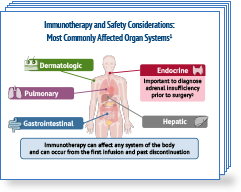
Practical Guidance on Managing Adverse Events Associated With Immunotherapy Regimens for Nonmelanoma Skin Cancers
1 12-01-2026Sunandana Chandra, MD, MS
Northwestern University
Chicago, Illinois
In this module
- Getting on the Same Page in NMSC Management: Reviewing the Adverse Event Profiles of Immunotherapeutic Regimens
- A Graded Approach to Management of Key Immunotherapy-Related AEs
- Getting Real About Immunotherapy Use in Practice: Recognizing Complex Cases
- United We Stand Against Immunotherapy-Related Adverse Events: A Multidisciplinary Approach
- Using Patient-Centered Strategies to Improve Long-Term Survivorship on Immunotherapy
0.5 CME CREDIT • OCTOBER 18, 2024
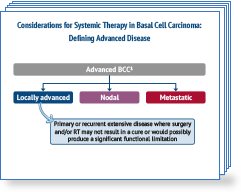
Selecting and Sequencing Systemic Treatment for Advanced Basal Cell Carcinoma
1 10-17-2026Vishal A. Patel, MD
George Washington University School of Medicine and Health Sciences
Washington, D.C.
In this module
- Considering Patients’ Candidacy for Systemic Therapies for BCC: A Review of Recommendations
- Evaluating the Efficacy of Systemic Therapies for Patients With Advanced BCC
- Weighing the Safety Profiles of Systemic Therapies for Patients With Advanced BCC
- Clinical Decision Point: When to Sequence From HHIs to Immunotherapies in the Treatment of BCC
- Practical Management Approaches to Boost Patients’ Persistence With Immunotherapies for BCC
0.5 CME CREDIT • SEPTEMBER 6, 2024
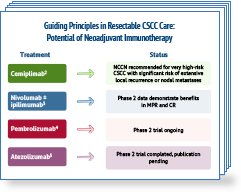
Neoadjuvant Immunotherapy for CSCC: Practical Considerations for Resectability, Patient Selection, and Treatment Optimization
1 09-05-2026Vasu Divi, MD, MS
Stanford University
Stanford, California, USA
In this module
- An Evolving Landscape: Guideline Recommendations for a Neoadjuvant Immunotherapeutic Approach in Patients With Resectable CSCC
- Defining Resectability: Patient Selection for Neoadjuvant Immunotherapy for Resectable CSCC
- Exploring the Clinical Impact of Neoadjuvant Therapies in Resectable CSCC: Efficacy
- Parsing the Safety of Neoadjuvant Therapies in Resectable CSCC
- Practical Strategies for Optimally Implementing Neoadjuvant Immunotherapy for Patients With Resectable CSCC
CROSSWALK: MEASURES & GUIDELINES
Education in this course could be used to address the following quality care metrics:
National Comprehensive Cancer Network (NCCN) Guidelines: Basal Cell Skin Cancer (Version 3.2024)
NCCN Guidelines: Squamous Cell Skin Cancer (Version 1.2024)
NCCN Guidelines Management of Immunotherapy-Related Toxicities (Version 1.2024)
ADDITIONAL RESOURCES
- Neoadjuvant Approaches to Non-Melanoma Skin Cancer
- Cemiplimab for Kidney Transplant Recipients With Advanced Cutaneous Squamous Cell Carcinoma
- Therapeutic Approaches for Non-Melanoma Skin Cancer: Standard of Care and Emerging Modalities
- A Clinician’s Roadmap to Improving Outcomes in Advanced Basal Cell Carcinoma: Guiding Principles for the Use of Immunotherapies
- Updates in Skin Cancer in Transplant Recipients and Immunosuppressed Patients: Review of the 2022–2023 Scientific Symposium of the International Immunosuppression and Transplant Skin Cancer Collaborative
Biography
Sunandana Chandra, MD, MS
Northwestern University
Chicago, Illinois
Sunandana Chandra, MD, MS is an Associate Professor in Medicine in the Division of Hematology Oncology at Northwestern University. Dr. Chandra is the Principal Investigator for a number of trials both in cutaneous and uveal melanoma, as well as nonmelanoma skin cancers, including Merkel cell carcinoma and cutaneous squamous cell carcinoma, and is the Co-Director of the Melanoma Biobank. She is involved in collaborations to identify predictive and prognostic biomarkers in the development and management of immune-mediated toxicities and is a Co-Investigator in an immunotoxicity biospecimen registry of patients being treated with immunotherapy. Furthermore, Dr. Chandra developed the inpatient Immunotoxicity Consult Service at Northwestern University to rapidly manage patients experiencing immune-mediated adverse effects.
Biography
Vishal A. Patel, MD
George Washington University School of Medicine and Health Sciences
Washington, D.C.
Vishal A. Patel, MD is an Associate Professor of Dermatology and Associate Professor of Medicine/Oncology at the George Washington University School of Medicine & Health Sciences. He serves as the Director of Cutaneous Oncology at the GW Cancer Center and the Director of Dermatologic Surgery at the GW Department of Dermatology. Dr. Patel is an expert in cutaneous oncology including the medical and surgical management of melanoma, high risk cutaneous squamous cell and basal cell carcinomas and Merkel cell carcinoma. His research interests focus on the use of topical, intralesional, and systemic adjuvant and neoadjuvant immunotherapy in high-risk cutaneous malignancies, as well as the role of artificial intelligence and gene expression profiling for risk assessment of skin cancers.
Biography
Vasu Divi, MD, MS
Stanford University
Stanford, California, USA
Vasu Divi, MD, MS is an Associate Professor of Head and Neck Surgery in the Department of Otolaryngology-HNS at the Stanford University School of Medicine. His clinical practice focuses on advanced cutaneous malignancies, oral cavity carcinoma, and microvascular reconstruction. His research interests include the use of neoadjuvant immunotherapy in advanced cutaneous squamous cell carcinoma. He was a site-PI in the national trial evaluating neoadjuvant cemiplimab and is the PI for a recently completed investigator-initiated trial using neoadjuvant atezolizumab in cSCC. He currently is working on a cooperative group trial to evaluate neoadjuvant therapy in immunocompromised populations.
FACULTY
Sunandana Chandra, MD, MS
Northwestern University
Chicago, Illinois
Vishal A. Patel, MD
George Washington
University School of Medicine
and Health Sciences
Washington, D.C.
Vasu Divi, MD, MS
Stanford University
Stanford, California, USA
Accreditation for this CME activity is provided by Global Education Group. This activity is developed in collaboration with Answers in CME and the Skin Cancer Outcomes Consortium (SCOUT).


This activity is intended for US healthcare professionals only.
© 2018-, Answers in CME
Terms of Use | Privacy Policy | Contact Us | Sign Up for Activity Alerts
